
😶🌫️ 🧠
Some work of mine
A glimpse into the way I tackle opportunities.

Dollarshaveclub.com
NSRQ (NO SUBSCRIPTION REQUIRED)
Dollar Shave Club was always known for being a razor subscription company. As the company grew so did the way we thought about the business. With new products and sub-brands being launched regularly the interest and demand for them grew from members, non-members and past members. One of the major draw backs of the Dollar Shave Club parent brand for many consumers is they could only purchase our other offerings if they had a razor subscription. So, listened to the consumer base and decided it was time to knock down the barrier of needed a subscription to become a member of the club.
NSRQ is an acronym for, “No subscription required”. We will be rolling out the MVP of this initiative in Q1 of 2016 to all DSC digital properties (web + mobile). The introduction of NSRQ means that non-members can visit the site or app and make NRP purchases without a razor subscription being required.
As we evolve the business and our web and mobile platforms, the cart or, “Box” has to evolve it’s logic for different use cases and user states. This chart is a high-level peek into the different use cases for the box when it’s opened from the main navigation icon link and what primary elements it contains at any given point.
Integrating this business model into our digital platforms took much thought and careful auditing. We had to comb through every consumer facing touch point and create proper flows so that our past, present and future members did not feel confused or mis-lead.
With the phase 2 NSRQ test, we are introducing a test to see if people are willing to purchase a razor subscription if we present them an interstitial screen to up-sell a razor. We will be testing 2 different versions. In one, the guest will have the ability to select a single razor (4x or Exec) and the second test would be a more educational screen explaining the benefits of a razor subscription.
As briefly discussed in the user flows above, we had to design for all member types, which meant designing custom authenticated account pages for those different user states. Whether the member came in through purchasing a non-razor product, a razor subscription, they are a past member or they are an active member with a suspended credit card, their content hierarchy on their account page was different.
We not only had to create all these consumer facing changes, we changed the way the business looked at this members. We called this, the user states refactor.
BRAND PAGE REDESIGN
For 2 months we conducted many moderated and remote usability test to pin-point what exactly users were having trouble with in navigating dollarshaveclub.com. One big concern among many members and non-members was the display of our products and ability to way-find on our brand product listing pages. From these insights, we developed a strategy to create a flexible system that met the needs of many different departments throughout the company and most importantly, our users.
In starting the wireframe concept phase, I started wide and hi-level to explore structure first. As soon as we tested a few structured that worked we moved into more hi-fidelity wireframes to test out these concepts in execution. When creating a new tile structure for the website we had to consider all the permutations of that tile and how it could live and evolve, which took a tremendous design exercise.
As you've seen from the sample above we molded these tiles into every shape we possible could think of. Then we wanted to pressure test with the structure, so we created the document below to communicate to stakeholders what you could and could not do with the new system. We had to do this because rules are everyone's best friends when it comes to systematic design. When introducing a new system to the site, we wanted to make sure that it was not being abused. The company could use big tiles (2/3) or small tiles (1/3) in the grid.
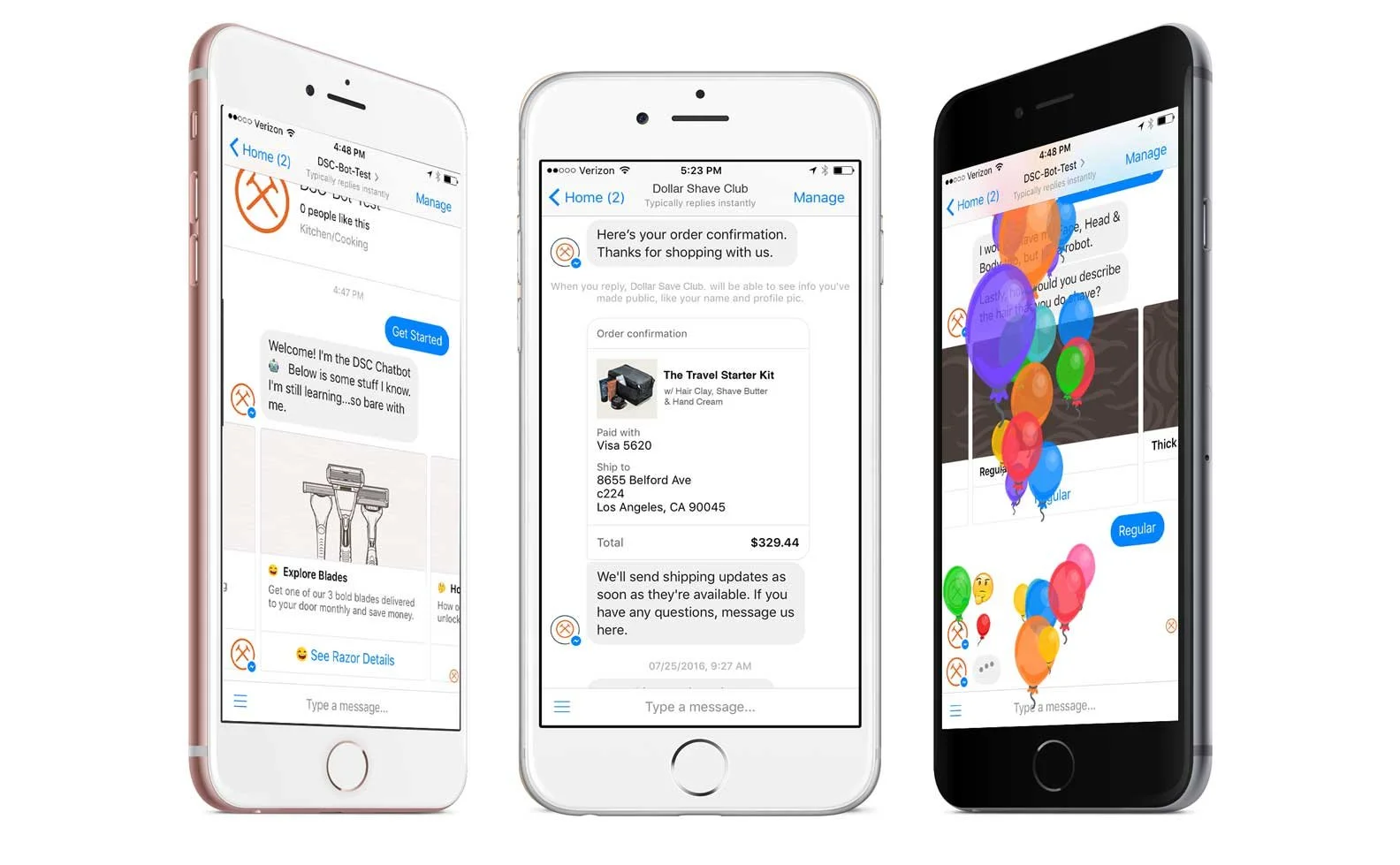
DSC Facebook Bot
PLATFORM OVERVIEW
While Artificial Intelligence (AI) is not a new concept by any means, it's still relatively new in the design realm. Engineers have been working at making AI and machine learning as a whole smarter and more independent for years. At Dollar Shave Club, our brand has something unique that no brand in our category and not many other brands have, a defined and distinguishable voice and tone. From day one when our CEO Mike Dubin busted onto the scene with the outlandish and some would say daring viral video, it set the tone of the brand in a way that the Internet had not seen at that time.
Fast-forward 5 years and the way brands can speak to consumers has changed dramatically. We've got new communication channels opening up every week and the main-stream is adopting these new channels at a rapid pace.
THE DESIGN PROCESS
When I was managing the Summer UX Intern, I gave him an assignment to explore how bots could positively effect both our brand perception and the end-users experience in finding the right products for them. Naturally, we started prototyping on Facebook Messenger platform, primarily because that's the channel that we spend a majority of our marketing and acquisition dollars. Oh, and it's our most effective / highest converting acquisition channel. We iterated through a few ideas and ended up with a bot that's sole purpose was to help you find the right Boogie's hair-styling product for your needs. As we shopped the idea and proof of concept around to different departments, we needed to work through a large bot strategy if it was to actually live.
DEVELOPING SCOPE & USER NEEDS
Like any project, what we thought we were building ended up being something completely different once it was built. Hell, it's probably different as you read this. We change(d) it everyday. Through our quant research and analyzing quant data, we evaluate the dead ends and what exactly people want out of this bot. Bots are different than any interface you'll ever design. You can think of a strategy, the best strategy you could possibly think of, but at the end of the day people will use it how they want. And bots, are the extreme case of this. The amount of use cases are hard to manage, which makes formal UX documentation kind of pointless. For something that is forever evolving, growing and getting smarter, what's the point?
In order to sell this channel in at the Executive level, we needed the bot strategy and data to prove why we should invest in it. By interviewing and gathering data from our Member Service team (MSA), we mapped the current MSA touch points with our members and the time of day. Doing this helped discover an opportunity, automation through Facebook Messenger. With 800+ messages from members a week (and growing) and a more than 24 hour response time, we could surely add a customer service layer to the bot which would eliminate 78% of MSA contacts through this channel. Those 78% of contacts we would be eliminated through automation are often times 'one-touch' tickets in which the member has a simple one response question.
As a business, DSC's goal is that we want to help members find the best grooming regime for them across our entire product portfolio. What started as a prototype that we were testing remotely with users, turned into something much longer. Essentially, this project fed into my OCD, really bad. But that's a good thing. I continued to refine and refine and refine. As guests and members would use the bot I would tweak flows multiple times daily and add to the Natural Language Processing (NLP) with every conversation. Eventually, the bot got to a really good place. Between the constant communication with the DSC Member Service team, guests and members, the NLP and overall MVP feature set of the bot was ready to launch. This process really helped open a lot eyes to people in the company. It helped them realize that we can invest little resources and little time to produce a platform or new channel to communicate with our members and potential members.
After calculating all of the current Facebook Messenger data we had available to use, we decided to start with FAQs and basic Member Service as we dove into the development of the bot. Daily, we would meet with the DSC Member Service team because they are on the front lines, speaking with and answering member concerns every second of every day. The whole Member Service team helped pin-point exactly what people were asking for and how they were asking. One of the first features of this track that we implemented was live-chat. This, we assumed, would be used quite frequently for frustrated members who just was an actual human to speak to. ChatFuel has a really awesome live-chat hand off to the Zendesk Messenger platform, which is what we leveraged for this functionality and to collect all Facebook Messenger tickets moving forward.
As we the Member Service portion of the bot became more sophisticated and functioned off natural language pretty smoothly, we transitioned into remote usability testing with real members and non-members. We ended up testing the bot in 4 different phases of its development with 50 non-members and 30 members. This helped uncover great features that help members beyond just FAQs and member help. Some of these features include: DSC Razor Match Tool, Subscription to latest DSC Original Content articles, search and read Original Content articles based on various tags, detailed flows of a few member favorite products and easy exposure to all of our grooming brands and categories.
Another insight from our usability testing was that whenever we enjected more emojis, fun language, non-sensical conversation or funny .GIF, the delight factor and love reaction we heard from the test participants was very noticeable. As the remote usability testing progressed we collected 5 words that described their experience with the bot and this interaction changed their perception of the brand, from each test participant.